Transcription Audio
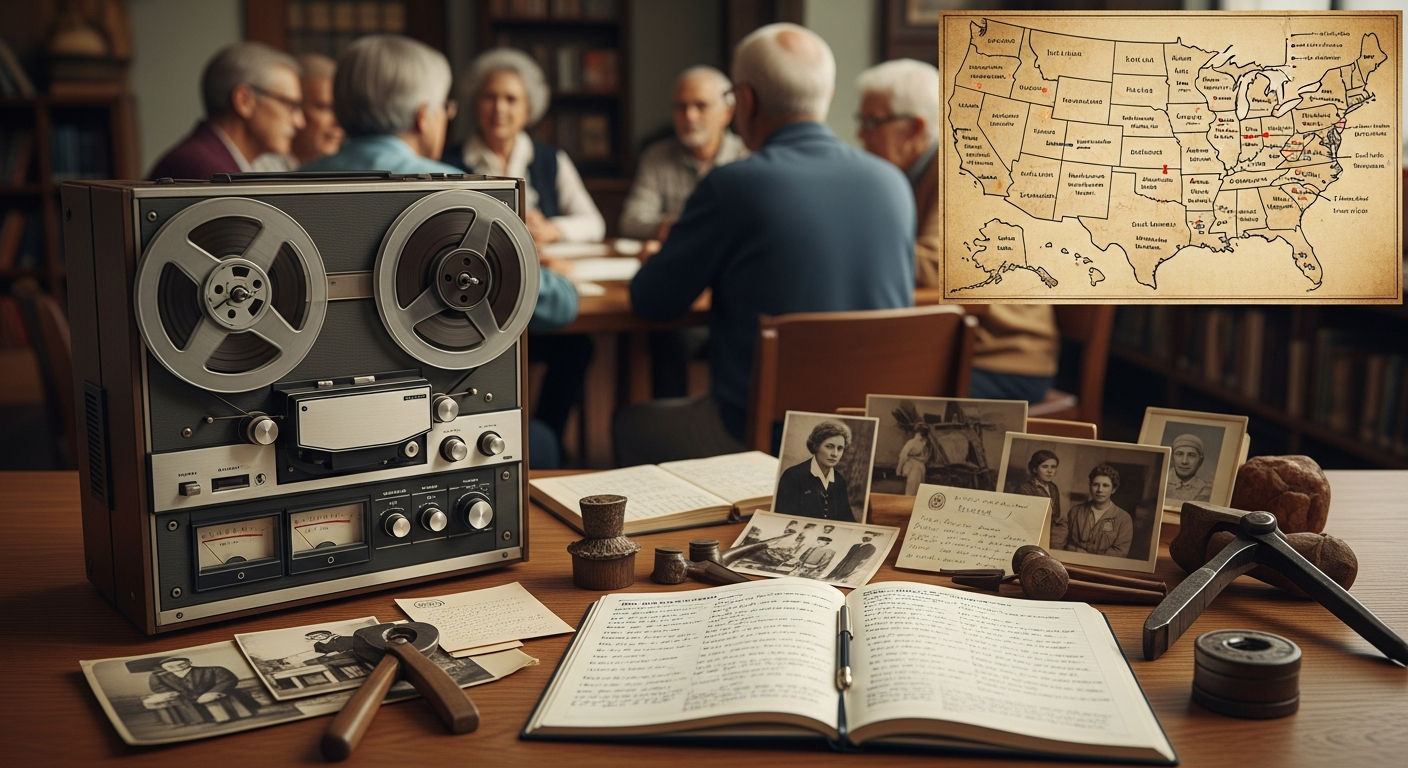
Why Preserving Local Dialects Is Important for Historians in U.S. Local History, Artifact Management, and Oral Histories
13 novembre 2025
Listen to audio:
Transcript Text
Hello and welcome. Today, I want to take you somewhere you can’t get to with a map—into the sound of a place. Picture this: I’m in a small-town museum in the Upper Midwest, holding a steel lunch pail that belonged to a mill worker named Joe. It’s solid, scuffed, heavy with use. On the shelf above it is a dusty cassette labeled “Joe—break room stories.” I press play, and suddenly the lunch pail isn’t just a relic. Joe’s voice—his vowels, his rhythm, the names of machines and people—turns the pail into a portal. The object has a story, yes. But the voice gives it a time, a neighborhood, friendships—a whole world. That’s our point today: preserving local dialects isn’t a nice-to-have. It’s historical evidence. It anchors artifacts, clarifies oral histories, and turns “interesting” into “accurate.” Save the sound of a place—its accent, vocabulary, and storytelling—and you strengthen the record. Think about how we piece together the past: objects, documents, interviews. Dialect is the fourth corner of the frame, holding everything steady. A community’s voice can be a timestamp. How certain vowels rise or relax has shifted across decades. If you have a letter with phonetic spellings, or a recording where someone says pin and pen the same—or very differently—you can often place that voice within a decade. It’s like watching a Polaroid develop. The picture sharpens. If you’re cataloging family letters, notice how cousins spell a neighbor’s name or stretch a vowel in a note that mimics conversation. Those little choices can help date a bundle of papers with surprising precision. Detective work that starts in the ear. Dialect is also a kind of GPS. Migration leaves footprints in speech. The Great Migration, when millions of Black families moved from the South to cities like Chicago and Detroit, reshaped language you can still hear on street corners and in church basements. In the Lowcountry, Gullah Geechee communities carry features that trace to specific islands and neighborhoods. If a family story says, “we came up for work in the auto plants around 1940,” and a taped interview echoes that journey, those clues reinforce each other. The voice can confirm the path on the map. Dialect ties people to networks—who worked with whom, who worshipped together, who spent long days on boats or in fields. Cajun English in south Louisiana, the shorthand of ranch hands in South Texas, the sing-song of Pennsylvania Dutch English—each signals belonging. And that belonging explains your collection. The handmade knife isn’t just a blade; it’s a tool from a shrimping crew that shared a dock and a Saturday dance. The union badge on the shelf? Hear the slang from the union hall and you’ll know if that badge got you into meetings, onto a strike line, or just through the factory gate. The language around an object often reveals more than the object itself. There’s also power in this story. Language carries the history of who got to speak in public and who didn’t. Words used in African American communities during Jim Crow, captured in oral histories, document strategies of resistance and care that never made it into official minutes. Scan school board archives and watch “Spanish” shift from “foreign” to “heritage.” That wording marks changes in policy—and respect. Track shifts over decades and you can see power moving around the room. And don’t forget the language of work. A fisherman’s log from the Outer Banks reads like code until someone from that community says the words aloud and explains them. Same with timber terms in Pacific Northwest diaries, or nicknames for machines in Rust Belt factories. Pair a tool with the words workers used—how they said it, not just what—and three out of four mystery objects suddenly make sense. That hook wasn’t for what you thought. That saw wasn’t for that cut. The voice unlocks the technique. Even the musicality of a place matters. The long, spiraling ballads of the Appalachian mountains, the quick, layered talk of New York City—these shape memory. Read a transcript and you get the facts. Listen to the breath, the pauses, the laughter, the circle back for a final reveal—that’s where a community’s memory lives. How a story is told is part of the story. Here’s the kicker. When communities record their own voices alongside their objects, researchers are far more likely to link items to the right time and place. Think of it this way: out of ten tricky objects, adding the voice gets you four more correct matches than documents alone. For anyone who has stared at a ledger or a farm tool and thought, “what am I looking at,” that’s a big swing. So if the case is so strong, why isn’t everyone doing it? Most museums and local history groups say voice matters. But only about one in three has a plan to capture and catalog dialects systematically. The gap isn’t belief—it’s workflow. And that’s solvable. Treat dialect as data, not decoration. That changes everything. It means we don’t ask people to “put on” an accent. We don’t cherry-pick funny phrases. We don’t subtitle in ways that caricature a community. Instead, we ask permission. We describe voices respectfully. We link what we hear to specific objects, places, and dates. We credit speakers. We share copies with families. We let communities decide how and where their voices travel. Where to start? Keep it simple and human. - When an elder brings in a quilt, ask to record a short story about who taught them to sew, and the words they use for stitch patterns. - If a high schooler donates their abuela’s rosary, ask them to describe how their family prays—in the language they learned it. - If someone drops off a cigar box of fishing lures, invite them to name each one aloud, the way their dad did, and describe the water the day that lure worked. Link those clips to the object record. Note the date, the place, and any words they say are “ours.” Educators, this works in class. Ask students to collect a few family words—nicknames for foods, names for chores, a holiday phrase. Map those words to a recipe card or a photograph. Your bulletin board becomes a dialect atlas, and your students’ families see themselves as history makers. A quick word about ethics. Voices are personal. They can be sensitive. Always make sure folks know what you’ll do with a recording. Let them set boundaries—public, private, or local only. Co-describe their dialect with them: does this label feel fair? Would you change a word? Their voice, their say. If you’re thinking, “I love the why, but I need the how,” the written version of this episode has checklists: how to make a short town glossary, how to note pronunciation without getting too technical, and how to tag recordings so future researchers can actually find the accent or vocabulary you captured. You don’t need to become a linguist. You just need to listen closely and connect what you hear to the objects and places you care for. A few small habits with outsized impact: - Write down local terms exactly as people say them, in quotes, and ask what they mean in daily life. “We go crabbing down the flats at dead low.” “He worked the number three blast.” “We take the cut-off by the old mill.” The words point to places and processes. - Collect a minute of “how we talk” alongside every major object—one minute. That tiny habit builds a library fast. - Make space for storytelling style. If someone needs five minutes to circle their tale, let them circle. That’s where the meaning lives. When we do this well, something beautiful happens. An inscription that looked plain becomes a joke that only makes sense in one neighborhood. A guessed-at date becomes certain because the pronunciation matches a generation. A tool that sat unlabeled for years suddenly belongs to a trade and a town, because the words gave it back its job. And the reward isn’t just for researchers. It’s for the visitor who hears their auntie’s voice in the gallery. For the kid who realizes the way their grandpa says Tuesday and roof is part of history, not a mistake. For the family who didn’t think the museum had room for them—until the museum sounded like them. Dialects are memory you can hear. They carry identity, migration, skill, humor, and power. They don’t sit beside history; they shape it. So let’s stop treating them like atmosphere, and start treating them like evidence. If you want to go deeper, the article that inspired this episode lays out practical steps you can use tomorrow. But you don’t need a perfect plan to start. Press record—with consent. Ask one good question. Capture one local word. Pair one voice with one object. Do that a few times, and you’ll feel the room change. Back in that small-town museum, the curators added a QR code to Joe’s lunch pail. Visitors hold up a phone and hear him describe the “number two furnace” in a cadence that rises at the end—proud, a little tired. That voice didn’t just explain the pail. It put us all on the factory floor at shift change. That’s the point. The sound of a place is the past, alive and present, waiting to be heard. Thanks for listening—and if this sparked ideas, the full guide has the details to help you make it real. Now go collect a story the way you hear it back home.