Transcription Audio
5 Keys to Unlock Your Local History Project: Community-First Timing
13 novembre 2025
Listen to audio:
Transcript Text
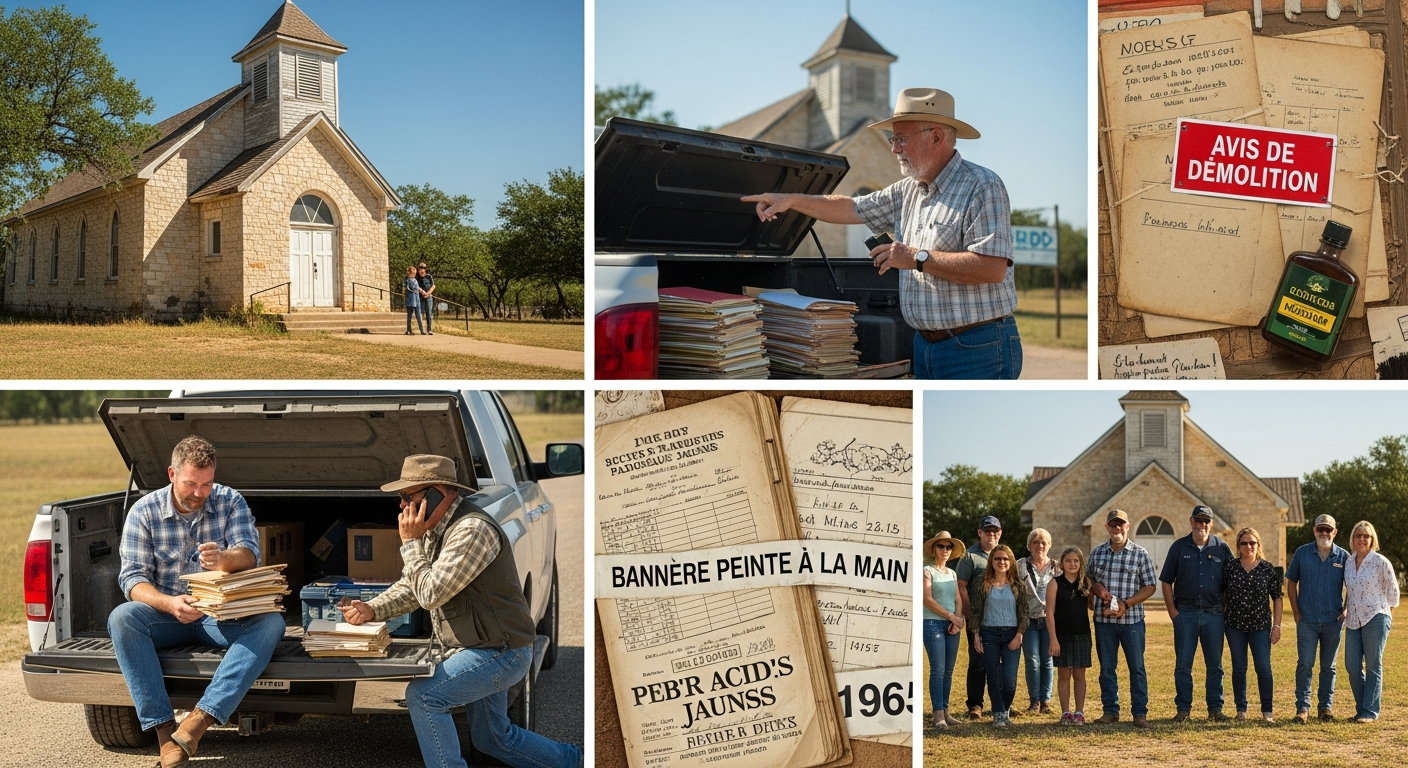
Hello and welcome. Come with me to an August afternoon in East Texas, the kind of hot that makes the air feel like syrup. I’m in the back of a pickup with a box of acid-free folders on my knees, trying to keep them from sliding into a puddle of sweet tea. We’re idling by a cinderblock church about to be demolished so a county road can be widened. Deacon Moore—straw hat, gentle voice, eyes like a ledger—is calling cousins: “Right now, if you can, baby.” I’ve got a grant clock ticking, a school district waiting, and a stack of student release forms for a fall unit on local history. But that day taught me something I won’t forget: it wasn’t my calendar that mattered. This church wasn’t just a building. It’s where the first Black veterans in town met in the 1940s. Where the Freedom Summer bus stopped in ’64. Where sweet-potato pies showed up every Homecoming. We’d known about the demolition for a month, and my plan was by-the-book: document the site, record interviews, and have everything ready for 4th graders by October. It should have worked. It didn’t. We approached the congregation in July. Polite nods, a little interest, but no one wanted to be recorded. The artifacts—ledgers, a hand-painted 1965 voter registration banner, a box of hymnals—stayed locked behind the pulpit. I felt urgent. Storms were coming. Bulldozers were scheduled. School starts when school starts. But the elders didn’t match my pace. Miss L. looked at my very official forms and said, “Sweetheart, we’re still deciding how we feel.” So I did the one thing I’m worst at: I waited. While I waited, I prepared. I got a letter from the county confirming the demolition timeline. I made sure we’d have access with the deacon’s permission. I built a mobile digitization kit—scanner, gloves, camera, extension cords. I worked with a teacher to pencil in a November project day, just in case. But I didn’t push the interviews. Because good oral history isn’t extracted. It’s offered. The turning point wasn’t a meeting or a grant. It was a Sunday announcement: the church would hold a final Homecoming before demolition. People were coming back from Dallas, Houston, Little Rock. “If you want to ask about how it was,” Deacon Moore said, “that would be the day.” That’s when it hit me: I’d been working the permit timeline, not the people timeline. On Homecoming, the work felt like one part logistics, one part listening, one part sweaty improvisation. We started with the artifacts because paper plus humidity equals heartbreak. We set a folding table near an outlet, rolled out the scanner, pulled on nitrile gloves, and the deacon’s cousin unlocked the storage room. The ledgers were brittle but readable. The hymnals were miraculously mold-free. We photographed everything where it sat, recorded people’s identifications in their own words—what I call oral captions—and gave each item a temporary ID. It sounds tiny, but in the classroom it’s huge. Imagine a student reading, “Ledger entry, June 5, 1947: cake sale to send boys to ag college,” and then hearing Miss L.’s voice explaining who baked the cakes and why. Between services we set up two chairs in the shade. No lights, no boom mics. Just a camera, simple consent forms, and cold water. People didn’t line up. They drifted. Miss L. started with, “I don’t think I remember much,” and then told me exactly where the Freedom Summer bus parked, who brought lemonade when someone slashed the tires, and how the choir switched from hymn 192 to 204 when the deputy walked in. That’s when you realize timing isn’t just your schedule. It’s when memories surface. When the community is ready and the story is present. At the photo wall, someone had taped up snapshots—baptisms at the creek, a Thanksgiving soup line, a softball team in hand-stitched uniforms. People pointed and argued in the best way. We recorded names, dates, and disagreements. “That’s Pearl with an ‘ea,’ child, not ‘u.’ She’ll haunt you if you get it wrong.” There was laughter. There were tears. And then, true to August, a thunderstorm built over the trees and we wrapped the scanner before the rain did what rain does. So, when should you do field research for a local history project? After that day, I started answering, “Whenever the community is ready and the story is present.” Getting there takes intent. Here are five keys that changed my practice and my students’ outcomes. First, have a laser-focused question, and say it out loud. Your question is your North Star and your invitation. Ours was, “What was the social and civic role of Pleasant Grove Baptist Church in Larkspur from 1940 to 1980?” Tight enough to steer choices, open enough for rich stories. Without that, you collect everything and understand nothing. When community members hear a clear question, they know how to help. Miss L. heard ours and said, “Oh honey, you need to talk to Deacon Williams’ widow. She kept all the meeting minutes.” If your question fits on an index card and you can say it in one breath, you’re ready to ask it in a church parking lot, a front porch, or the cereal aisle. Second, ride the people calendar, not just the paperwork calendar. Permits, grants, and school schedules matter. But the days that open memory are Homecoming and Juneteenth, treaty anniversaries and county fairs, tournament weekends and choir reunions. Those gatherings do two things you can’t buy: they bring the storytellers home, and they tell everyone’s brain, “It’s time to remember.” Ask one simple planning question: When are folks already coming back? Build around that. You’ll get more stories with less arm-twisting. Third, prepare without pressing. Patience isn’t passivity. While you wait for the right moment, do the stuff that makes the moment safe and smooth. Line up permissions in writing. Scout power outlets. Pack a kit that fits in a tote and sets up in five minutes. Have gloves that fit small hands and big ones. Bring water and snacks. Put a tarp in the trunk in case the sky opens up. Give yourself a backup date with your teacher partner. Garden first; harvest later. Fourth, make participation easy and dignified. Two chairs in the shade and a consent form you can explain in thirty seconds beat a forest of gear. Ask how people want to be named. Pronounce names correctly. Offer the pause to think and the option to stop. Stories are gifts. You don’t yank them out like weeds. You open your hands and receive them. If someone says, “Not today,” you say, “I hear you,” and you mean it. That “no” can turn into a “yes” next month—and a chorus down the line. Fifth, capture context in the moment and share back fast. That’s why I love oral captions. When someone points at a ledger and says, “That was the cake sale for the boys,” record that voice with the image. Jot down names, spellings, and how people want to be credited. Give each item a simple temporary ID so you can match audio to image later. And then, share back quickly. Even a small preview—three scanned pages, two labeled photos, a minute-long clip—says, “We heard you, we’re careful, and your history matters.” That sparks corrections, additions, and trust. In classrooms, students hear Miss L. beside the ledger and learn that history isn’t dusty. It’s living, breathing, stubbornly specific. Underneath all five keys is one big idea: timing is a team sport. It’s not just your deadline. It’s the deacon’s call list, the aunties’ recipe cards, the veteran’s quiet afternoon, the cousins flying in from Houston, the choir switching from hymn 192 to 204 when someone in uniform walks in. If you show up when the community is already gathering, and you come with focused curiosity, steady preparation, and open hands, the work moves. It stops feeling like extraction and starts feeling like collaboration. One more thing I learned under that stormy August sky: there’s power in disagreement and laughter. When someone argues over whether that’s Pearl with an “ea” or an “iu,” and everyone laughs, you’re watching the community edit its own archive. A month later, when students study those photos and hear those debates, they get the message: history isn’t a single voice. It’s a circle of chairs. If you’re itching to start your own project, try this. Write your question on an index card. Ask a community elder when folks are coming home next. Pack a small kit. Set two chairs in the shade. Bring more water than you think you need. And when someone says, “We’re still deciding how we feel,” believe them—and make space for that decision. That space is where trust grows. And trust is where the good stories live. If you want the nuts and bolts—the how-to on digitizing safely, authenticating artifacts, or recording great oral histories—those are in the written guide. What I want you to carry from today is simpler: go when the people are ready and the story is present. Do your homework, but let the community set the tempo. That’s the difference between a project that transforms students and one that collects dust on a shelf. The day the storm rolled in and we packed the scanner, Miss L. squeezed my hand and said, “You got what you needed?” I told her the truth. We got what we were given. And it was more than enough. Thanks for listening. Now go find your two chairs in the shade, and I’ll meet you there.