Transcription Audio
13 Essential Insights Into the Salem Witch Trials That Still Resonate Today
31 décembre 2025
Listen to audio:
Transcript Text
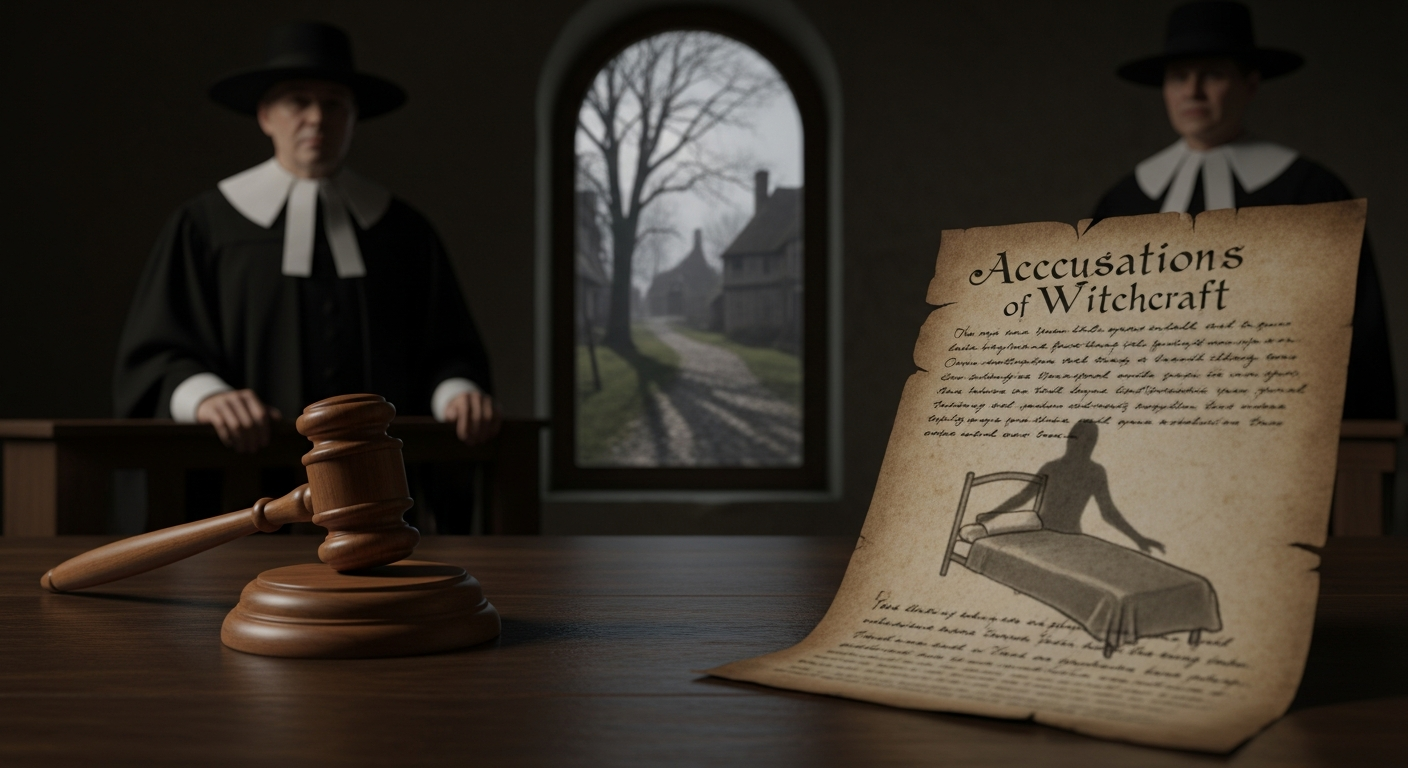
Hello and welcome. Today we’re traveling back to 1692, but not for a ghost story. This is a story about us—about fear, power, and what happens when a community stops asking the most important question in any crisis: How do we know? The Salem Witch Trials weren’t really about witches. They were about the deadly chain reaction that starts when anxiety meets authority and evidence gets tossed out the window. I want you to imagine a cold Massachusetts winter, houses huddled together, neighbors watching neighbors. The sermons are heavy, the rules are strict, and whispers move faster than the snowstorm outside. Into that pressure cooker, one idea spreads: the devil is among us. And once that idea takes hold, it becomes useful—useful to the frightened, to the angry, and to the powerful. The engine of this panic was a courtroom trick that sounds absurd today but was deadly then: spectral evidence. Think of it like this. Someone says your “spirit” pinched them while you were at home asleep. That vision, that dream, that feeling? It could be presented as evidence in court. You could be condemned for something invisible—something no one could test, verify, or disprove. It’s like being hauled into a courtroom right now because someone swears they saw your avatar commit a crime in their nightmare. That wasn’t a legal glitch; it was a theological loophole with teeth. Puritans believed that spiritual warfare was real, as real as your kitchen table. Influential ministers like Cotton Mather argued that the devil could take the form of innocent people—but only if those people somehow gave permission. So if someone claimed to see your specter tormenting them, the assumption baked into that belief was that you were complicit. The invisible suddenly had legal weight, and fear got a badge and a gavel. Here’s the part that still chills me: out of the twenty people executed, spectral evidence was decisive in the vast majority of cases—think three out of four. Martha Corey, a respected church member, was condemned largely because people claimed her specter pinched and tormented them. Her husband, Giles Corey, asked for something radical: real proof. For refusing to enter a plea—refusing to play by the rules of a rigged game—he was pressed to death under heavy stones. That wasn’t medieval Europe. That was colonial New England, and it happened because the burden of proof got flipped on its head. So let’s pause and try a thought experiment. What if our courts today allowed testimony about what someone did in a dream? What if a trending rumor on social media could send you to prison because it felt true to enough people? That’s what spectral evidence did. It turned fear into a weapon and replaced evidence with belief. And once belief sits in the judge’s chair, reason becomes a defendant. Now, the story gets even more complicated when we talk about the “afflicted girls”—Betty Parris, Abigail Williams, Ann Putnam Jr., and others. They were young, yes, but they weren’t just random kids having strange fits. They were children in a high-pressure world: strict religion, constant warnings about the devil, family tensions, and the aftershocks of conflict on the frontier. Imagine growing up where every headache might be a sign of Satan, where adults hang on your words because they’re terrified of what you might reveal. Suddenly, these girls who normally had very little power found themselves at the center of the universe. Were they master manipulators? Were they traumatized? Were they acting out the scripts the adults handed them? Here’s what we can say: they learned quickly that their accusations were believed. Their words moved the entire village. And once the adults—ministers, magistrates, neighbors—validated those claims, the girls’ stories became the oxygen of a moral firestorm. It’s dangerous to make them the sole villains. They were children operating in a system that rewarded fear and punished doubt. This is the part that still resonates today. When a community is stressed and divided, when leaders elevate feelings over facts, when the loudest voices get treated like the truest voices, the ground tilts. Maybe you’ve seen a version of this online. A rumor catches fire. Screenshots fly. People pick sides before anyone asks the boring but essential questions: What actually happened? Can we verify it? Who benefits if we don’t? Salem shows us what happens when we fail that test. The judges, trusting their theology more than their senses, allowed a kind of evidence you can’t test. Neighbors, already suspicious of each other, found a righteous outlet for resentment. And the accused? They were trapped. How do you disprove an invisible crime? You can’t. That’s the point. The process itself became a punishment. This is why those trials still matter. We live in a world of invisible forces—algorithms shaping our feeds, narratives shaping our beliefs, anxieties shaping our politics. When we accept claims we can’t test, when we treat a feeling like a fact, we reenact the logic of spectral evidence. Salem may feel far away, but the pattern is not. Let’s go back to Giles Corey for a moment. He refused to enter a plea, knowing the courts had tilted beyond reason. That refusal cost him his life, and it’s one of the most haunting details in the story. Not because it’s brutal—though it is—but because it reveals a deeper truth. Sometimes the only way to protest a broken system is not to play the game. Giles Corey becomes a warning and a question: when the rules reward fear, what will you stand for, and what will you refuse? And then there’s Martha Corey. A respected member of the church, she doubted the accusations and paid with her life. Her story isn’t just tragic; it’s instructive. It shows how quickly a community can turn on dissent. In Salem, skepticism itself became a suspicious act. Imagine that in your world: asking for proof becomes the thing that gets you punished. That’s when you know you’ve slipped from justice into zealotry. So what do we do with a story like this, apart from shiver at the injustice? First, we remember the human cost behind big words like hysteria. These were families torn apart, bodies buried, reputations scorched. Panic has a price tag. Second, we recommit to the safeguards that Salem abandoned: the presumption of innocence, the demand for testable evidence, the courage to say “I don’t know yet.” Those aren’t just legal standards; they’re cultural habits. They’re how a community keeps fear from wearing a badge. And third, we stop telling ourselves that we’re immune. The Salem villagers were not cartoonish zealots. They were human beings trying to make sense of nightmares—spiritual, social, and real. Their mistakes are human mistakes. That’s why they’re so instructive. If we imagine we’re smarter than them, we’ll miss the moments when we repeat them—when we participate in a pile-on, when we tune out doubt because it’s inconvenient, when we treat a compelling story as a concluded case. If there’s a single takeaway I hope stays with you, it’s this: beware of invisible evidence. Beware of claims that cannot be tested, challenged, or falsified. Whether it’s a rumor, a vision, or a narrative that flatters our fears, if it asks us to skip the hard work of verification, it’s inviting us to Salem. The written article dives deeper into the legal mechanics, the theology, and the social fractures that powered this crisis—how the courts bent, how belief overran reason, how ordinary people got caught in extraordinary pressure. But you don’t need footnotes to feel the heartbeat of the lesson. Justice requires friction. Truth requires patience. And courage often looks like the quiet insistence on asking simple questions, even when everyone else wants a quick, satisfying answer. One more thought before we wrap. It’s easy to look at 1692 and say, “That would never happen now.” But every time a headline, a thread, or a viral post tells us exactly whom to fear and exactly whom to blame—and we accept it without asking how we know—we step a little closer to that meetinghouse in Salem. The antidote isn’t cynicism. It’s curiosity. It’s the willingness to say, “Show me.” It’s the humility to admit when the evidence isn’t there yet, and the resolve to protect the people caught in the middle until it is. Salem doesn’t just warn us about superstition. It warns us about certainty without scrutiny, about panic without process, and about the intoxicating rush of being part of a righteous crowd. The crowd feels good, until the stones start piling up. Thanks for listening, and if this stirred your curiosity, the full write-up has more to explore—how spectral evidence rose and fell, how the community unraveled, and how the echoes of Salem still ripple through the ways we judge and the ways we fear. Until next time, keep your mind open, your standards high, and your courage steady.